5 Mistakes US Companies Make Expanding into EMEA
30 Dec 2025
5 Mistakes US Companies Make Expanding into EMEA
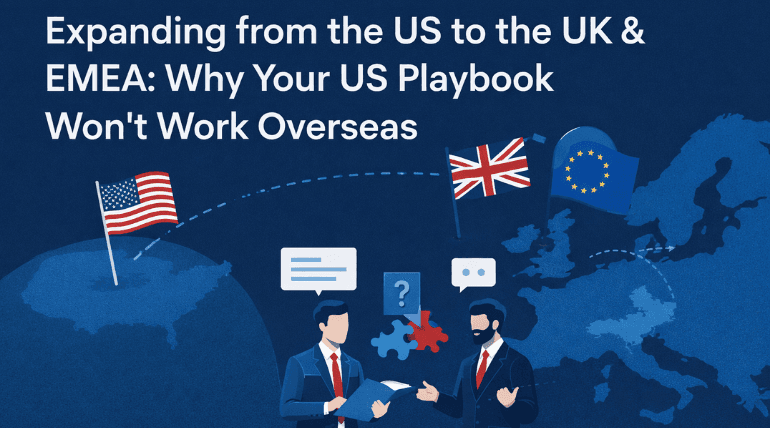
Expanding from the US into the UK and wider EMEA can unlock significant growth — but it’s also where many otherwise successful US companies stumble. The assumption that what worked in the US will work everywhere else is one of the biggest risks businesses face when entering Europe.
This article explores the most common pitfalls US companies encounter when expanding into the UK and EMEA, and what successful organisations do differently.
The Biggest Misconception: Europe Is Not One Market
One of the first mistakes US companies make is treating EMEA as a single, homogenous region. In reality, Europe is made up of dozens of distinct markets, each with its own:
Language and cultural norms
Buying behaviours
Regulatory requirements
Sales cycles and decision-making processes
Competitive landscapes
A message that resonates in the US (or even in the UK) may fall flat in Germany, France, the Nordics, or Southern Europe. Local relevance matters far more than global consistency.
Mistake #1: Using a Single Global Messaging Strategy
Many US companies attempt to run a single global positioning and messaging framework, assuming it can simply be translated for local markets. This rarely works.
European buyers expect:
Less hype and more substance
Clear articulation of value, not just vision
Proof points that are relevant to their market
Messaging that reflects local challenges and priorities
Direct, high-energy US marketing language can be perceived as overly aggressive or vague in parts of Europe. Successful companies adapt their messaging while keeping the core value proposition intact.
Mistake #2: Reusing the US Go-To-Market Playbook
US go-to-market strategies are often optimised for:
Large addressable markets
Faster sales cycles
Centralised decision-making
Heavier reliance on outbound sales
In contrast, many UK and EMEA markets require:
More education-led selling
Longer sales cycles
Multiple stakeholders across regions
Strong local credibility and relationships
What works in San Francisco or New York may not work in London, Amsterdam, or Munich. Successful expansion requires building a regional playbook, not copying the US one.
Mistake #3: Assuming One Hire Can Cover All of EMEA
Another common mistake is believing that hiring "a strong salesperson" or "a regional manager" is enough to cover the entire EMEA region.
EMEA is vast. Expecting one person to:
Understand multiple markets
Sell across cultures and languages
Navigate different legal and commercial norms
Build pipeline across multiple countries
is unrealistic and often sets that hire up to fail.
Successful companies recognise that people are not interchangeable, and that skills, experience, and cultural understanding matter deeply.
Mistake #4: Treating Talent as Fully Transferable
A strong US hire does not automatically translate into EMEA success.
European markets value:
Local market experience
Existing regional networks
Understanding of procurement and compliance processes
Familiarity with local buying behaviours
Training alone cannot replace lived experience. Hiring locally )or partnering with experienced regional leaders) is often the difference between slow traction and sustained growth.
Mistake #5: Underestimating Regulation and Compliance
Regulation is a much bigger factor in EMEA than many US companies expect.
Examples include:
GDPR and data protection
Country-specific employment laws
Procurement and vendor requirements
Sector-specific regulations
Ignoring or underestimating these requirements can slow deals, create legal risk, and damage trust with European customers.
What Successful US-to-EMEA Expansions Do Differently
Companies that expand successfully into the UK and EMEA tend to:
Treat Europe as multiple markets, not one
Localise messaging while keeping a consistent core narrative
Build regional go-to-market strategies
Hire for specific skills and market knowledge
Invest in local leadership early
Respect cultural and regulatory differences
They balance global alignment with local execution.
The Role of Local Leadership
Many successful expansions rely on experienced local leaders — often fractional or interim — who:
Bridge the gap between US HQ and local markets
Translate strategy into regional execution
Build early credibility with customers and partners
Help avoid costly missteps in hiring and positioning
Local leadership is not a cost; it’s an accelerator.
Final Thoughts
Expanding into the UK and EMEA is not about copying what worked in the US. It’s about adapting intelligently.
Global ambition requires local understanding. Companies that recognise this early are far more likely to build durable, scalable growth across Europe.


